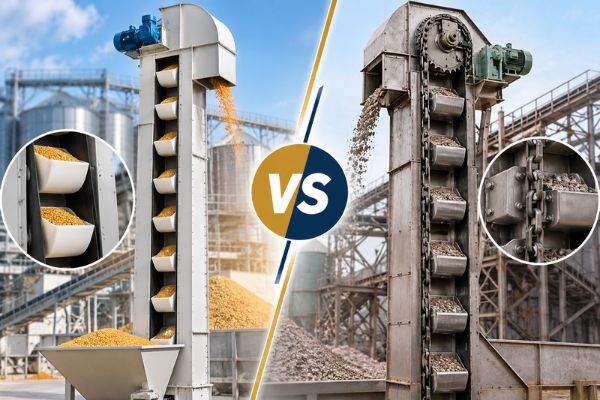
Which Bucket Elevator Fits Your Material and Operating Conditions
A belt bucket elevator is often suitable for bulk materials within the selected belt’s temperature and loading limits. A chain bucket elevator can be considered for hotter or demanding material duties. The correct choice depends on the complete operating conditions, including particle size, abrasiveness, capacity and lifting height.
Compare the proposed design against your actual material. Cool cement powder and hot clinker present different operating requirements.
How Belt and Chain Bucket Elevators Differ
Both systems lift material in buckets inside a casing. The difference is how the buckets are carried.
| Buying Consideration | Belt Bucket Elevator | Chain Bucket Elevator |
|---|---|---|
| Bucket Support | Buckets attached to a belt | Buckets attached to a chain |
| Temperature Assessment | Confirm the belt’s continuous and peak temperature ratings | Confirm ratings for the complete chain assembly |
| Material Suitability | Fine or coarse material, depending on design | Hot or demanding material duties, depending on design |
| Maintenance Discussion | Belt condition, tracking, splice and attachments | Chain wear, elongation, sprockets and attachments |
| Quotation Comparison | Belt specification and pulley arrangement | Chain specification and sprocket arrangement |
When a Belt Bucket Elevator Makes Sense
Consider a belt arrangement when the material temperature stays within the approved belt rating and the design meets your capacity requirement. Suitable applications may include grains, cement powder, fertilizers and minerals.
Check belt strength, bucket attachments, loading and discharge when assessing a proposed belt design.
Abrasive material does not automatically rule out a belt elevator. Specially designed heavy duty belt systems can handle some coarse or abrasive materials. Ask which construction and wear protection suit your material.
When a Chain Bucket Elevator Deserves Consideration
A chain arrangement deserves attention when the process involves hot material or a demanding conveying duty. Clinker and certain mineral applications may require a chain design assessed for temperature, wear and loading.
The word chain does not guarantee suitability. Chain type, attachment strength, bucket construction and sprocket selection must match the application.
Discuss how abrasive particles affect moving components and how wear will be checked. A suitable chain arrangement also needs access for inspection, adjustment and replacement.
Why Temperature and Material Data Come First
Provide normal material temperature and the highest expected temperature, including how long peaks last. A short temperature peak and continuous hot operation can require different assessments.
Also share bulk density, maximum lump size, particle distribution, moisture and abrasiveness. These details influence bucket filling, component loading and wear.
Avoid applying a temperature limit taken from another manufacturer’s catalogue. Ask the supplier to confirm the rating of the equipment being offered, including its belt or chain, attachments, seals and other affected components.
How Capacity and Discharge Affect Selection
Specify both normal throughput and maximum required output. Capacity in tonnes per hour should be assessed alongside bulk density because bucket filling involves material volume.
Lifting height, inlet feeding and outlet position also influence the design. Downstream equipment must be able to receive the discharged material.
Belt or chain describes the carrying arrangement. Centrifugal or continuous describes the discharge approach. These are separate design decisions. Discuss acceptable material damage and discharge behaviour when reviewing the complete elevator.
Compare Maintenance and Ownership Costs
Compare the purchase price with expected maintenance work, replacement parts and shutdown requirements. Ask how technicians reach inspection points and remove worn components.
For belt designs, discuss tracking, belt tension, splice inspection and bucket fasteners. For chain designs, discuss wear measurement, elongation, sprockets and the take-up arrangement.
Discuss suitable condition monitoring and its connection to plant controls. Confirm included devices and maintenance responsibilities before operation.
Request a Quotation Based on Your Plant Requirements
Forderin Reich is a bucket elevator manufacturer and supplier in Ahmedabad, serving industrial projects across Gujarat and India. Its range includes belt, chain, centrifugal and continuous bucket elevators.
To request a useful quotation, send material data, normal and peak capacity, lifting height, operating hours and a layout drawing. Ask for the recommended configuration, component specifications, drive details, maintenance access and supply exclusions.
Compare offers using the same project requirements. Review the available bucket elevator options and request a quote for your plant.
Conclusion
Choose a bucket elevator by matching the complete design to the material and operating duty. Confirm temperature limits, capacity, discharge behaviour and maintenance requirements before comparing prices. A clearly defined specification helps buyers select equipment they can operate and maintain within their plant.
Frequently Asked Questions
A belt arrangement may offer a lower cost for suitable duties. Compare quotations with equivalent capacity, lifting height, materials, controls and installation scope before deciding which offer provides better value.
Some heavy duty belt designs can handle abrasive material. Share particle size, temperature and wear characteristics so the manufacturer can assess the belt, bucket attachments and protection required.
Ask for a temperature assessment of the complete equipment. Continuous temperature, peak exposure and material characteristics should guide the recommendation and the supplier’s written operating limits.
A conversion requires an engineering review. Casing dimensions, loading, drive, supports and connections may need changes. Compare the conversion scope with a replacement before approving the project.
Confirm capacity for the stated material, lifting height, operating conditions, discharge requirements and acceptance checks. Record the agreed performance basis in the order and approved drawings.
Ask for identified wear parts, supply lead times, replacement procedures and maintenance access. Confirm how technical support will be provided at your plant location.
Ask for both activities to be clearly included or excluded. Confirm responsibility for erection, alignment, wiring, inspections, trial operation and operator guidance before finalising the order.